
In my work with thousands of people, I have head people saying, often very confidently, “I know I’m capable. I just don’t feel it when it matters.”
That sentence if often a clear indicator of self-doubt.

It is rarely a lack of talent or lack of preparation. Often, it is a quiet split inside the person.
One part says, “Go.” Another part says, “Stop. You might get exposed.”
And when that second voice keeps interrupting at the worst possible moments, people start looking at hypnosis for self doubt.
Fair enough. But before you decide whether hypnosis is useful, it helps to ask a better question than most people ask.
Not “Can hypnosis make me confident?”
A more important question is, “What is this self-doubt actually doing in my mind, and can hypnosis help me see or change that pattern?”
That question gets us somewhere.
What hypnosis for self doubt is really addressing
Self-doubt is not always the enemy people think it is. Sometimes it is an old protective strategy wearing an important-looking suit.
Think about it.
When do people doubt themselves most? Usually before visibility, risk, decision, conflict, or change. Before speaking up. Before raising prices. Before leaving the wrong relationship. Before starting the business. Before setting the boundary. Self-doubt often appears exactly where something meaningful is about to happen.
So what is it protecting?
Is it protecting you from failure? From embarrassment? From disapproval? From making a move you cannot take back? From becoming more visible than your old identity can comfortably handle?
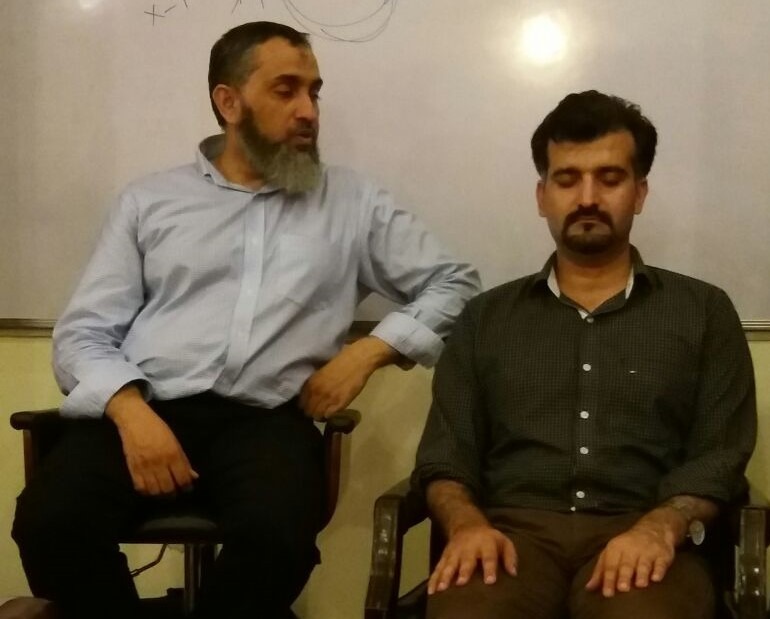
That is where hypnosis can be useful.
Not because it sprinkles confidence dust on your nervous system. It can help shift the automatic patterns underneath conscious effort.
In a good session, you are not being turned into a superhero. You are seeing and influencing the internal process that keeps producing hesitation, second-guessing, and internal friction.
In other words, hypnosis for self doubt is less about installing confidence and more about loosening the grip of old associations, predictions, and meanings.
That distinction matters.
Why positive thinking often fails
Many intelligent people have tried to solve self-doubt by arguing with it.
They repeat affirmations. They make vision boards. They tell themselves, “I am enough” with the enthusiasm of someone reading legal terms at the bottom of a contract.
And still, when the real moment arrives, their body tightens, their thoughts scramble, and the old pattern returns.
Why?
Because self-doubt is often not a logic problem.
You may consciously believe you are capable, but unconsciously associate visibility with danger, mistakes with humiliation, success with pressure, or being fully expressed with rejection. If those links exist, then your behavior will often follow the deeper map, not the nicer sentence.
This is one reason hypnosis can help where surface-level self-talk does not. It allows a person to access the level where those patterns are running more automatically.
But let me be clear.
Hypnosis is not magic, and it is not mind control. If someone sells it to you as a mysterious force that overrides your humanity, walk away briskly.
Hypnosis is better understood as a focused state in which attention narrows, internal experience becomes more noticeable, and suggestion or insight can land more directly. Useful? Yes. Mystical? Not required.
How hypnosis for self doubt can help
When I use hypnosis, I am not trying to force confidence into someone like software into an outdated laptop. I am paying attention to how the self-doubt is organized.
- What triggers it?
- What pictures, memories, or imagined consequences appear just before the person pulls back?
- What identity is being protected?
- What conclusion did they make years ago that still runs today, even though it no longer makes sense?

Sometimes the person is still reacting to a school experience, a critical parent, a humiliating meeting, or a period of life where caution was sensible. But here is the interesting part: the event itself is not always the issue. The meaning attached to it is.
A person can carry one old interpretation for twenty years without questioning it. “If I get it wrong, people will lose respect.” “If I speak with certainty, I’ll seem arrogant.” “If I really go for it and fail, I won’t recover.”
Notice how absolute these sound. Self-doubt loves certainty when it is making negative predictions.
Hypnosis can help interrupt that certainty. It can create enough mental flexibility for a person to experience a different response, sometimes for the first time in years. The inner movie changes. The emotional charge shifts. The automatic pause weakens.
Not because they were broken and got repaired, but because they finally saw the machinery.
What good hypnosis does not do
This is where nuance matters.
Hypnosis for self doubt is not a substitute for skill.
If you are unprepared, hypnosis should not be used as a glittery distraction from reality. If your pricing is confused, your communication is vague, or your boundaries are nonexistent, those issues still need attention.
It also does not mean every ounce of self-doubt should disappear. Some hesitation is intelligent. Sometimes doubt is feedback. Sometimes it is showing you that you need more clarity, more practice, or a more honest decision.
So the real question is not, “How do I eliminate self-doubt forever?”
It is, “Is this doubt useful information, or is it an old pattern pretending to be wisdom?”
That is a very different conversation. And frankly, a more grown-up one.
Why hypnosis works better with insight
Here is what I have seen for years: change lasts longer when people understand the pattern, not just when they feel temporarily better.
If a person uses hypnosis only to relax, they may feel relief. Relief is nice. I am not against nice. But if they never see how they have been constructing self-doubt through interpretation, expectation, memory, and internal rehearsal, the pattern often rebuilds itself.
This is why I tend to begin with investigation.
- How do you know you are doubting yourself?
- What exactly happens first?
- Do you hear a voice, see a future failure, remember an old embarrassment, compare yourself to someone else, or tighten your body and then call that feeling “truth”?
Slow that down and something fascinating happens. The person begins to separate from the pattern. They stop saying, “This is just who I am,” and start noticing, “This is something my mind has been doing.”
That shift alone can be powerful.
Then hypnosis has somewhere intelligent to go. It is no longer a random technique applied to a vague problem. It becomes a precise intervention aimed at a pattern that can actually be observed.
Is hypnosis for self doubt right for everyone?
No. And that answer should make you trust the process more, not less.
Some people respond beautifully to hypnosis because their mind easily engages with imagery, suggestion, and internal focus. Others need more conversational work first because the self-doubt is wrapped in layers of overthinking, analysis, and identity protection.
I often find that people need to be dehypnotized from their imaginary limitations and dysfunctional logic more than anything else, and that removed their self-doubts too.
Some need to understand before they can let go. Others need to experience something different before understanding catches up.
It depends on the person.
It also depends on the practitioner. If someone treats hypnosis like a script they read at you, that is usually a bad sign. Self-doubt is personal. It has structure. It has history. It has logic, even when that logic is outdated. Good work pays attention to that.
Everyone is unique and I do not have one solution for all, kind of approach. This is why I do not focus on techniques.
A generic confidence recording might relax you. It might even help a little. But if your self-doubt has a very specific trigger pattern, general suggestions may miss the mark entirely.
The deeper opportunity inside self-doubt
Here is the part most people miss.
- Self-doubt is not just painful. It is revealing.
- It shows you where your identity is still negotiated by old rules.
- It shows you where approval has too much influence.
- It shows you where you have confused discomfort with danger.
- And it shows you where your mind would rather rehearse limitation than risk being surprised by your own capability.
That last one stings a little, I know.
But it is worth asking:
If your self-doubt disappeared tomorrow, what would you have to do that you can currently postpone? What conversation would you need to have? What decision would become unavoidable? What responsibility would you no longer be able to hide from?
Sometimes people cling to self-doubt because it gives them a respectable delay.
That is not a moral failure. It is just something to notice.
So yes, hypnosis for self doubt can be effective. Not as a performance trick. Not as a replacement for honesty. And not as a magical confidence injection.
It can help when it is used to uncover and shift the deeper pattern that keeps making hesitation feel necessary.
If your mind has been repeating the same old warning for years, perhaps the most useful step is not to fight it harder, but to examine it more carefully. A lot of freedom begins the moment you stop treating every doubtful thought like expert testimony.

I am a Master Trainer of NLP & Hypnosis and a Personal Human Detective. I am the founder of The First Institute of Dynamic Learning, LLC. I study patterns of thinking, emotion, and behavior, and help people gain clarity through them.
My work is designed for mentally healthy individuals seeking clarity and personal development, and is not a replacement for therapy, medical treatment, or psychiatric care. Anyone currently working with a mental health professional should continue doing so.